
McDonald’s Loses Trademark Opposition Case
The Provincial Court confirms that, however well-known a trade mark may be, an opposition will not succeed if there is neither sufficient similarity nor a real risk of confusion on the part of the public.
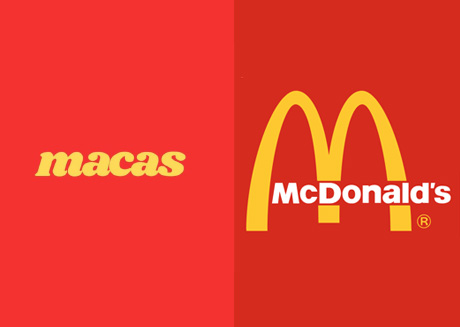 The judgment handed down by Section 32 of the Provincial Court of Madrid on 19 March 2026 (decision no. 103/2026) resolves the appeal lodged by McDonald’s International Property Company Ltd. (hereinafter, McDonald’s) against the decision of the Spanish Patent and Trademark Office (hereinafter, SPTO) which confirmed the registration of the ‘MACAS’ (figurative) trade mark in favour of FÁBRICA CHEF SL for catering products and services.
The OEPM issued a decision dated 18 March 2025, confirming the grant to Fábrica Chef SL of the registration of the figurative trade mark “macas” (in red and yellow), for classes 30 (sandwiches and hamburgers) and 43 (catering services) of the International Classification. The dispute arose from this registration, following an opposition filed by McDonald’s, in which it alleged a likelihood of confusion and association with its earlier trademarks — including McDONALD’S, BIG MAC, Mc and McCAFÉ — as well as the enhanced protection derived from the reputation of those trademarks in the catering sector.
After its opposition was dismissed both at first instance and on appeal before the Spanish Patent and Trademark Office (OEPM), McDonald’s brought the matter before the civil courts, seeking the cancellation of the registration of the ‘macas’ trade mark, invoking, on the one hand, Article 6.1.b) of the Trade Marks Act (hereinafter, TMA) (risk of confusion) and, on the other hand, Article 8 of the same Act (protection of well-known trade marks). McDonald’s argued that there is similarity because “macas” contains elements of its signs (“m” and “c”), phonetically incorporates “Mc”, and conceptually some consumers associate it with the trade mark. Furthermore, it argued that a minimal similarity is sufficient given the mark’s renown and that the colours red and yellow reinforce the link. Fábrica Chef, on the other hand, contended that there is no likelihood of confusion: “Macas” refers to the diminutive of “Macarena” and the colours red and yellow are common in the sector, without implying a business association.
Firstly, the Provincial Court notes that the protection of a well-known trade mark requires the cumulative fulfilment of five requirements: (1) the existence of a duly registered earlier trade mark; (2) the proven reputation of that trade mark; (3) a certain degree of similarity between the signs; (4) the possibility that the relevant public may establish a link of association between the trade marks; and (5) a risk of unfair exploitation, dilution or tarnishment of the earlier trade mark.
In this regard, the Provincial Court expressly acknowledges the existence of a duly registered earlier trade mark, as well as the reputation of the McDonald’s trade marks, but considers that the essential requirement of sufficient similarity between the signs is not met. From an overall assessment — as required by the case law of the CJEU — it concludes that ‘macas’ differs from the opposing marks phonetically, visually and conceptually.
- From a phonetic perspective, it observes that the expression “macas” does not reproduce the prefix “Mc”, nor does it have a structure or sound comparable to the marks cited, nor does it create a similar overall impression ( ). In this regard, it points out that the only opposing trade mark in which the syllable “mac” appears is “Big Mac”, which has nothing to do with “macas” as a whole; the pronunciation of the opponent’s trade marks does not in any way convey the sound “macas” to a Spanish speaker.
- Visually, the court notes clear differences in the visual configuration: the textual composition of the signs appears very different to the observer; the mark applied for is printed in its own typeface, in yellow on a red background, which bears no resemblance to the opposing marks; furthermore, the colours red and yellow do not form part of any of McDonald’s trademark registrations, and therefore cannot be taken into account in the comparative assessment.
- Conceptually, it is noted that McDonald’s marks refer to the product/establishment ‘café’ or the name ‘McDonald’s’, whereas ‘macas’ is a Spanish term with its own meaning, which reinforces the absence of conceptual identity.
Furthermore, regarding the claim that in large parts of Spain the term “macas” is associated with a McDonald’s menu, the court considers that it has not been proven that the public perceives this term as a reference to McDonald’s, describing the evidence provided (mainly from social media) as insufficient and lacking in representativeness. Consequently, as no similarity or link between the signs is apparent, the court concludes that the necessary requirements for applying protection of the well-known trade mark are not met, ruling out both unfair advantage and damage to the distinctive character or reputation of McDonald’s trade marks.
As regards the second ground, relating to the likelihood of confusion under Article 6(1)(b) of the Trademark Law, the Court of Appeal notes that this requires, as a prerequisite, the existence of similarity between the signs. Given that such similarity has been ruled out, it considers it unnecessary to examine the likelihood of confusion in greater detail, despite the overlap in the sector of activity.
Finally, the court dismissed McDonald’s appeal in its entirety and upheld the validity of the registration of the ‘macas’ trade mark. It also ordered the appellant to pay the costs of the proceedings in accordance with the principle of objective liability.
In short, the judgment reaffirms that the reputation of a trade mark does not imply an absolute monopoly over certain elements (such as the prefix “Mc”) and that enhanced protection applies only where there is sufficient similarity to enable the consumer to establish a link between the conflicting signs.